• /
  • Blog

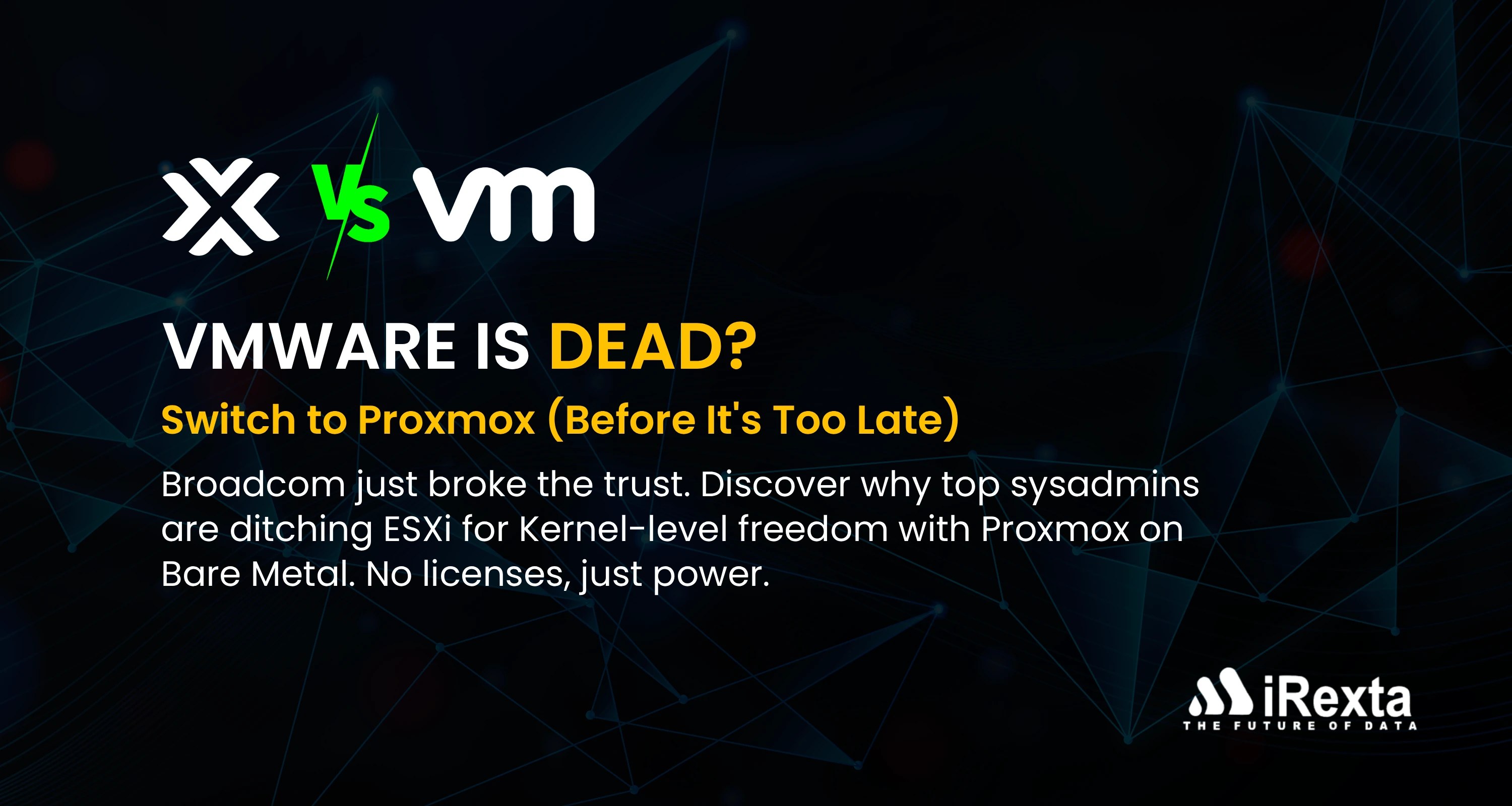
VMware is Dead? Switch to Proxmox Bare Metal

Broadcom didn't just buy VMware; they broke the contract of trust with sysadmins worldwide. Here is why the future of infrastructure isn't proprietary—it's Kernel-based.

The End of an Era: Why Leave VMware?

The era of "Defaulting to VMware" is over. With the recent Broadcom acquisition, the end of perpetual licenses, and the introduction of hostile pricing models like the 72-core minimum per CPU, IT directors are waking up to a harsh reality: You are renting your own hardware performance from a vendor.

For the technical elite, the migration to Proxmox VE on Bare Metal isn't just a cost-saving measure—it is a massive performance upgrade.

The KVM Advantage: Own the Kernel

VMware ESXi is a proprietary kernel. When it bugs out, or when it decides your Network Card (NIC) is "no longer supported," you are helpless. You wait for a patch or buy new hardware.

Proxmox VE is different. It turns your iRexta Dedicated Server into a Type-1 Hypervisor powered by KVM (Kernel-based Virtual Machine).

  • Debug with Standard Tools: Because it is Debian-based, you can use standard Linux tools htop, perf, strace to see exactly what your CPU is doing.
  • Hardware Freedom: If the Linux kernel supports your hardware, Proxmox supports it. No more "Purple Screen of Death" because you used a Realtek NIC or a Hybrid-Core CPU.

LXC: Why Pay the VM Tax?

One of VMware's biggest inefficiencies is its reliance on full Virtual Machines for everything. Every application gets a full OS, a full kernel, and full overhead.

Proxmox treats LXC (Linux Containers) as first-class citizens. Unlike Docker (which is application-level), LXC gives you a full system container sharing the host kernel.

The Result: Zero virtualization overhead. You can pack 3x more LXC containers on an iRexta Bare Metal server than you can VMware VMs.

ZFS: The "vSAN Killer" Included Free

VMware vSAN is powerful, but it is locked behind an expensive paywall and complex hardware requirements. Proxmox gives you ZFS (Zettabyte File System) out of the box. ZFS makes hardware RAID controllers obsolete.

  1. Bit-Rot Protection

    ZFS constantly checks data integrity. If a bit flips on the disk due to cosmic rays or hardware faults, ZFS detects it and repairs it automatically.

  2. ARC Caching

    ZFS uses your server's RAM as a high-speed read cache (Adaptive Replacement Cache), accelerating disk I/O significantly without needing expensive RAID cards.

  3. Instant Snapshots

    Take a snapshot of a 10TB database in 1 second. Roll it back just as fast. This capability is built-in, not an expensive plugin.

Conclusion: Stop Paying the Virtualization Tax

Broadcom has made it clear: they only want the Fortune 500. For the rest of us—the builders, the sysadmins, the hosting providers—the path forward is Open Source.

Migrating to Proxmox gives you Kernel-Level Control, Data Safety via ZFS, and complete freedom from licensing fees. Don't cripple your hypervisor with weak VPS resources. Deploy Proxmox on iRexta Dedicated Servers and experience the raw power of unmetered Bare Metal.
Recent Topics for you

Agentic AI Hardware Requirements: CPU vs GPU | iRexta

Agentic AI Hardware Requirements: CPU vs GPU | iRexta

Stop overprovisioning expensive accelerators. Understand why autonomous agents demand massive core density and how iRexta AMD EPYC servers deliver optimal inference performance.

AMD EPYC 8005 Bare Metal Server Review: The Engineering Truth

AMD EPYC 8005 Bare Metal Server Review: The Engineering Truth

Stop falling for hardware marketing illusions. Uncover the architectural realities of the AMD EPYC 8005 processor and how iRexta optimizes it for targeted storage workloads.

What 99.9% vs 99.99% Uptime Really Means (With Downtime Minutes)

What 99.9% vs 99.99% Uptime Really Means (With Downtime Minutes)

Stop falling for the SLA credit trap. Discover the true mathematics behind server downtime the hidden security risks causing outages and how dedicated infrastructure guarantees absolute availability.

Type 1 Bare Metal Hypervisors: Building a Private Cloud on Dedicated Servers

Type 1 Bare Metal Hypervisors: Building a Private Cloud on Dedicated Servers

Escape the commercial virtualization tax. Learn how Type 1 bare metal hypervisors transform dedicated servers into highly secure scalable private clouds.

Docker on Bare Metal: 2026 Private Cloud Guide

Docker on Bare Metal: 2026 Private Cloud Guide

Bypass the hypervisor tax. Learn why deploying Docker directly on bare metal servers with Coolify and NVIDIA GPUs is the ultimate 2026 cloud architecture.

Real-Time Deepfake Detection Infrastructure: Why Cloud VMs Drop Frames and Dedicated GPUs Win

Real-Time Deepfake Detection Infrastructure: Why Cloud VMs Drop Frames and Dedicated GPUs Win

Is your deepfake defense missing critical AI glitches? Discover how hypervisor latency causes dropped frames, and why security teams trust Dedicated Bare Metal GPUs for Zero-Trust video analysis.

The Silent App Killer: IOPS vs. Throughput

The Silent App Killer: IOPS vs. Throughput

You doubled your RAM and CPU, but your database is still crawling. Stop blaming your code. Here is the deep science of storage metrics and how to escape the "Provisioned IOPS" cloud trap.

DBaaS vs. Dedicated Servers: The Real Cost of "Convenience"

DBaaS vs. Dedicated Servers: The Real Cost of "Convenience"

Why high-growth startups are moving their databases back to Bare Metal to save money, boost IOPS, and escape the "Cloud Trap".

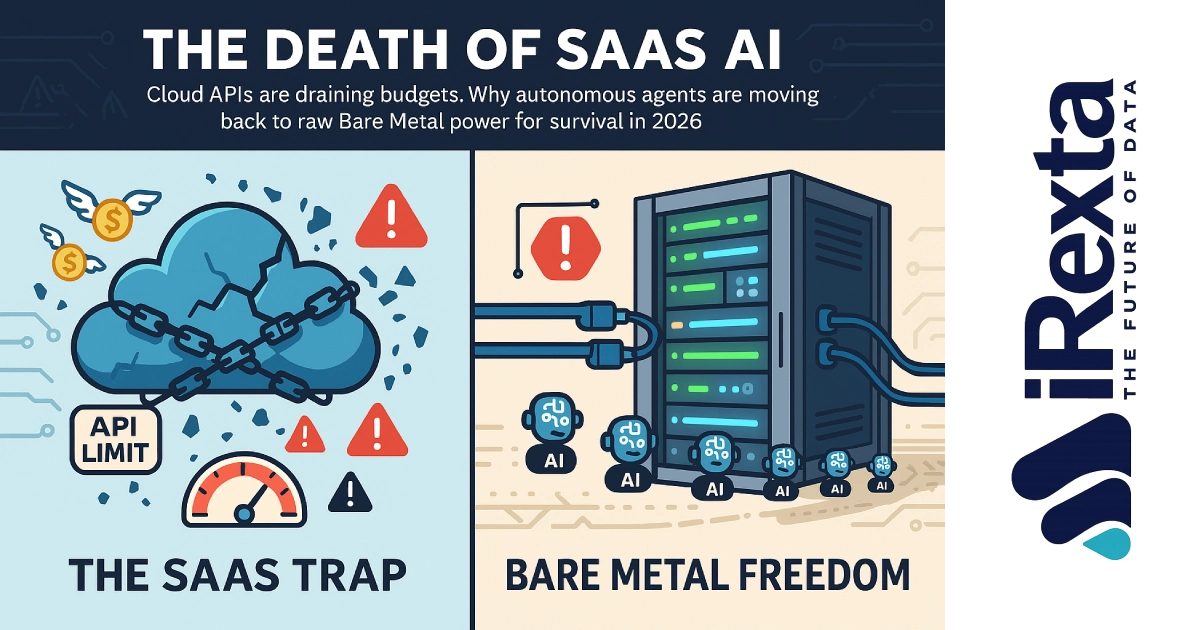
The Death of SaaS: Why AI Agents Are Moving Back to Bare Metal

The Death of SaaS: Why AI Agents Are Moving Back to Bare Metal

AI APIs and Cloud GPUs are draining budgets. Discover why the tech industry is shifting toward Bare Metal Dedicated Servers for running AI Agents in 2026.

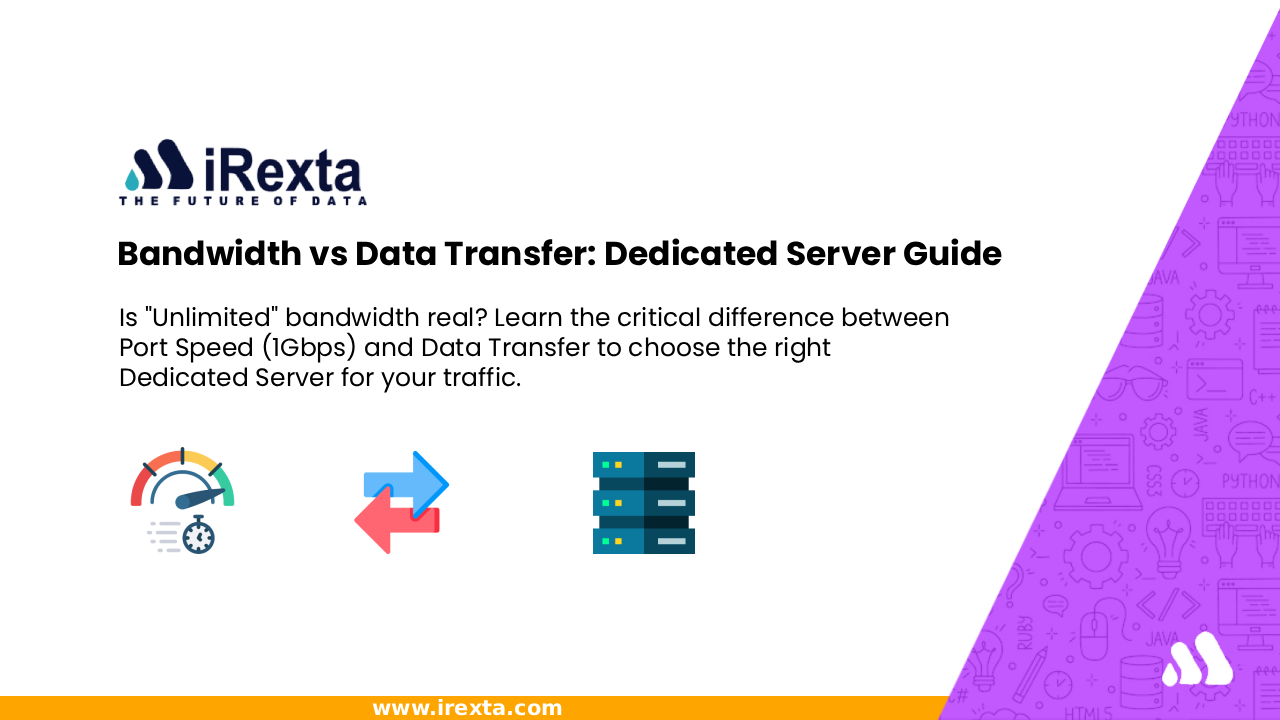
Website Bandwidth vs. Data Transfer: The Dedicated Server Guide

Website Bandwidth vs. Data Transfer: The Dedicated Server Guide

Confused by hosting specs? We break down the critical difference between Port Speed (1Gbps) and Monthly Transfer limits so you can stop overpaying for "Unlimited" lies.

VMware is Dead? Switch to Proxmox Bare Metal

VMware is Dead? Switch to Proxmox Bare Metal

Broadcom just broke the contract of trust. Learn why sysadmins are fleeing ESXi for Proxmox, KVM, and ZFS on iRexta Bare Metal.

Why Gaming Companies Are Switching to Bare Metal Servers

Why Gaming Companies Are Switching to Bare Metal Servers

Lag kills games. Discover why top gaming studios choose Bare Metal over Cloud for higher Tick Rates, lower latency, and zero Noisy Neighbors.

TLS vs. SSL: Key Differences & Why You Must Upgrade (2025 Guide)

TLS vs. SSL: Key Differences & Why You Must Upgrade (2025 Guide)

Confused about TLS vs. SSL? Our definitive guide breaks down the critical differences in security, encryption, and performance.

RAID 50 vs RAID 60: Which RAID Configuration Is Best for Your Server Needs?

RAID 50 vs RAID 60: Which RAID Configuration Is Best for Your Server Needs?

Confused between RAID 50 and RAID 60? Discover the key differences, performance comparisons, and best use cases. Learn which configuration suits your server setup in Denver or across Colorado.

Private Networking for Bare Metal Servers

Private Networking for Bare Metal Servers

Discover how private networking for bare metal servers boosts security, reduces latency, and saves bandwidth costs. Learn benefits, use cases, and how it works.

What Are the Risks of Not Having a Dedicated IP Address?

What Are the Risks of Not Having a Dedicated IP Address?

In today's interconnected digital landscape, a dedicated IP address plays a crucial role in ensuring secure, stable, and high-performance access to online services.

What Is the Difference Between SoftRAID and HardRAID? Which One Is Better?

What Is the Difference Between SoftRAID and HardRAID? Which One Is Better?

RAID, short for Redundant Array of Independent Disks, is a foundational technology used in data storage to improve performance, enhance fault tolerance, and ensure high availability.

1