• /
  • Blog

Agentic AI Security Risks: 6 Threats Enterprises Face

From prompt injection to cloud metadata exfiltration: Uncovering the engineering truth behind AI vulnerabilities, and why defense-in-depth requires more than just marketing promises.

Agentic AI vs GenAI: The Blast Radius Multiplier

Enterprise leaders are grappling with a rapidly evolving threat matrix. To understand the risk, we must address a core architectural distinction: Agentic AI vs GenAI. Traditional Generative AI tools are stateless and passive; they wait for a human prompt, generate a response, and stop.

Agentic AI systems, however, are autonomous workers. They interpret instructions, build multi-step execution plans, call APIs, query internal enterprise databases, and execute code autonomously. This capability is revolutionary for business efficiency, but it shatters the traditional enterprise security perimeter. We are no longer securing what a model says; we must secure what a system will do at machine speed.

Threat 1: Shadow AI Agents & The "Maker Mode" Trap

We all know about Shadow IT, but Shadow AI cybersecurity is vastly more dangerous. Developers are rapidly deploying open-source AI agents using frameworks like AutoGen or CrewAI without explicit security review. By the time security teams discover them, these unauthorized systems have already processed gigabytes of proprietary data.

The Hidden Danger: The critical vulnerability here is "Maker Mode." Agents are frequently deployed using the elevated, long-lived credentials of the developer who created them. In the context of AI, standard Role-Based Access Control (RBAC) mandates that an agent should NEVER possess human-level administrative privileges. If a "Maker Mode" agent is hijacked, the attacker gains the developer's full infrastructure clearance.

Threat 2: Cloud Metadata Exfiltration (The Infrastructure Flaw)

This is a massive vulnerability that traditional SaaS Data Loss Prevention (DLP) vendors frequently ignore. When you host an AI agent on a shared public cloud VM (like AWS or GCP), the agent is equipped with a Code Interpreter tool to execute Python scripts. Security researchers have proven that LLM agents can autonomously exploit the cloud provider's internal metadata endpoints.

SECURITY WARNING: The Cloud SSRF Attack Vector

An attacker can use indirect prompt injection to force the AI agent's code interpreter to execute a request against the cloud metadata service (e.g., http://metadata.google.internal/computeMetadata/v1/instance/service-accounts/default/token).

If successful, the attacker steals the Cloud IAM Access Token. This grants them the ability to bypass the agent entirely and directly compromise your underlying cloud infrastructure. Software sandboxes on public clouds cannot fully prevent this; hardware-level network isolation is required.

Threat 3: Unauthenticated MCP Servers

The Model Context Protocol (MCP) standardizes AI tool integration, but a vast majority of MCP servers are deployed internally with zero authentication controls, operating on the flawed assumption that "only our internal AI will call it."

If an attacker compromises a low-privilege agent, they can weaponize it to query unauthenticated MCP servers across your network. This turns the compromised agent into an internal proxy to siphon confidential databases or HR records it was never authorized to view.

Threat 4: Memory Poisoning & Cascading Failures

Memory Poisoning occurs when an attacker successfully manipulates the databases or documents that an agent frequently reads for RAG (Retrieval-Augmented Generation). If an attacker injects false context or a hidden LLM backdoor into the source data, the agent's memory becomes corrupted.

SRE Reality Check: Bare metal servers or infrastructure layers cannot save you here. Defeating memory poisoning requires cryptographic data signing, strict RAG data filtering pipelines, and continuous application-layer validation.

Threat 5: Data Leakage via Mounted Volumes

To allow AI agents to process large files, developers frequently mount host directories directly into the agent's Docker container. This practice breaks fundamental isolation principles.

SRE Reality Check: Even if you deploy on the most secure Bare Metal server, if a developer lazily mounts the root directory (/) into a Docker container, a hijacked AI agent can execute a script to steal every `.env` file, API key, and password on the machine. Volume scoping must be aggressively restricted using least-privilege principles.

Threat 6: Prompt Injection & Goal Hijacking

Indirect Prompt Injection is stealthy and lethal. Malicious instructions are hidden within a legitimate-looking webpage or document. Once the agent processes the tainted document, the hidden payload overwrites its core operational directives (Goal Hijacking), forcing it to forward corporate intelligence to an attacker.

SRE Reality Check: This is a 100% application-layer vulnerability. No server hardware, cloud provider, or hypervisor can prevent prompt injection natively. It requires dedicated LLM firewalls and rigorous input sanitization logic.

The Engineering Truth: Bare Metal Foundation + Defense-in-Depth

In the cybersecurity industry, there is a dangerous marketing fallacy that claims physical hardware alone solves all AI security risks. It does not. Hardware cannot fix application-layer vulnerabilities like prompt injection or memory poisoning. However, relying on shared public cloud infrastructure is an equally massive liability.

Bare Metal is the foundation, not the magic bullet. Hosting your AI Agents on iRexta Dedicated Bare Metal Servers completely eliminates Threat 2 (Cloud Metadata SSRF) and neutralizes hypervisor escape vulnerabilities natively, as there are no shared environments or noisy neighbors.

But to truly secure an autonomous agentic workflow, site reliability engineers must build a Defense-in-Depth architecture on top of that Bare Metal foundation:

  • Container Isolation (MicroVMs): Docker alone is insufficient because it shares the host kernel. To solve Threat 5 container escapes, you must deploy MicroVMs like AWS Firecracker or gVisor on your Bare Metal to cryptographically trap malicious code execution.
  • mTLS & API Gateways for MCP: To neutralize Threat 3 (Unauthenticated MCP Servers), never trust internal traffic implicitly. Route all agent-to-tool communication through an API Gateway or Service Mesh that enforces mutual TLS (mTLS) authentication, ensuring only cryptographically verified agents can access your data.
  • Zero-Trust Egress Filtering: If an agent gets hijacked via prompt injection (Threat 6), it needs an internet connection to exfiltrate your private data. Implementing strict outbound firewall rules (Egress Filtering) stops the data theft dead in its tracks.
  • AppArmor & Seccomp Profiles: Explicitly restrict the system calls (syscalls) that the agent's container is allowed to execute at the kernel level, neutralizing unauthorized lateral movement.

By starting with the raw physical authority of iRexta Bare Metal and applying uncompromising SRE isolation protocols, your enterprise can deploy autonomous AI with absolute, ironclad confidence.
Recent Topics for you

Agentic AI Security Risks: 6 Threats Enterprises Face | iRexta

Agentic AI Security Risks: 6 Threats Enterprises Face | iRexta

Autonomous AI agents operate at machine speed. Learn how to prevent prompt injection, memory poisoning, and metadata exfiltration using Bare Metal isolation and MicroVMs.

How to Secure AI Agents on Bare Metal Servers | iRexta

How to Secure AI Agents on Bare Metal Servers | iRexta

Stop relying on basic containerization. Understand the lethal trifecta of agent security and how iRexta bare metal servers provide absolute hardware isolation.

Agentic AI Hardware Requirements: CPU vs GPU | iRexta

Agentic AI Hardware Requirements: CPU vs GPU | iRexta

Stop overprovisioning expensive accelerators. Understand why autonomous agents demand massive core density and how iRexta AMD EPYC servers deliver optimal inference performance.

AMD EPYC 8005 Bare Metal Server Review: The Engineering Truth

AMD EPYC 8005 Bare Metal Server Review: The Engineering Truth

Stop falling for hardware marketing illusions. Uncover the architectural realities of the AMD EPYC 8005 processor and how iRexta optimizes it for targeted storage workloads.

What 99.9% vs 99.99% Uptime Really Means (With Downtime Minutes)

What 99.9% vs 99.99% Uptime Really Means (With Downtime Minutes)

Stop falling for the SLA credit trap. Discover the true mathematics behind server downtime the hidden security risks causing outages and how dedicated infrastructure guarantees absolute availability.

Type 1 Bare Metal Hypervisors: Building a Private Cloud on Dedicated Servers

Type 1 Bare Metal Hypervisors: Building a Private Cloud on Dedicated Servers

Escape the commercial virtualization tax. Learn how Type 1 bare metal hypervisors transform dedicated servers into highly secure scalable private clouds.

Docker on Bare Metal: 2026 Private Cloud Guide

Docker on Bare Metal: 2026 Private Cloud Guide

Bypass the hypervisor tax. Learn why deploying Docker directly on bare metal servers with Coolify and NVIDIA GPUs is the ultimate 2026 cloud architecture.

Real-Time Deepfake Detection Infrastructure: Why Cloud VMs Drop Frames and Dedicated GPUs Win

Real-Time Deepfake Detection Infrastructure: Why Cloud VMs Drop Frames and Dedicated GPUs Win

Is your deepfake defense missing critical AI glitches? Discover how hypervisor latency causes dropped frames, and why security teams trust Dedicated Bare Metal GPUs for Zero-Trust video analysis.

The Silent App Killer: IOPS vs. Throughput

The Silent App Killer: IOPS vs. Throughput

You doubled your RAM and CPU, but your database is still crawling. Stop blaming your code. Here is the deep science of storage metrics and how to escape the "Provisioned IOPS" cloud trap.

DBaaS vs. Dedicated Servers: The Real Cost of "Convenience"

DBaaS vs. Dedicated Servers: The Real Cost of "Convenience"

Why high-growth startups are moving their databases back to Bare Metal to save money, boost IOPS, and escape the "Cloud Trap".

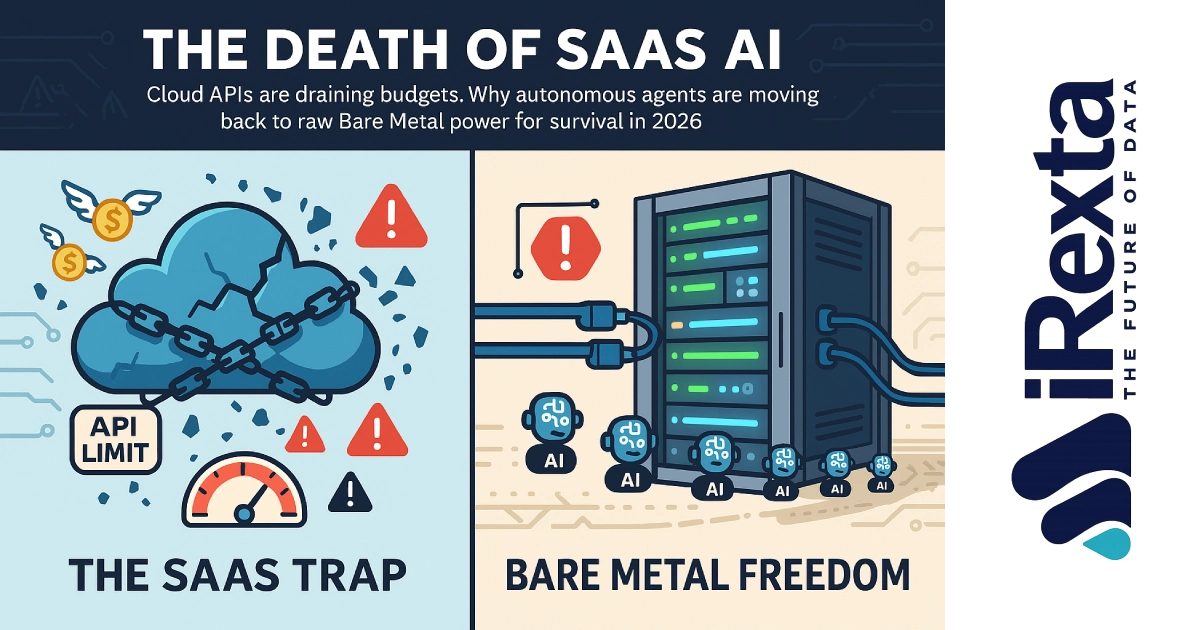
The Death of SaaS: Why AI Agents Are Moving Back to Bare Metal

The Death of SaaS: Why AI Agents Are Moving Back to Bare Metal

AI APIs and Cloud GPUs are draining budgets. Discover why the tech industry is shifting toward Bare Metal Dedicated Servers for running AI Agents in 2026.

Website Bandwidth vs. Data Transfer: The Dedicated Server Guide

Website Bandwidth vs. Data Transfer: The Dedicated Server Guide

Confused by hosting specs? We break down the critical difference between Port Speed (1Gbps) and Monthly Transfer limits so you can stop overpaying for "Unlimited" lies.

VMware is Dead? Switch to Proxmox Bare Metal

VMware is Dead? Switch to Proxmox Bare Metal

Broadcom just broke the contract of trust. Learn why sysadmins are fleeing ESXi for Proxmox, KVM, and ZFS on iRexta Bare Metal.

Why Gaming Companies Are Switching to Bare Metal Servers

Why Gaming Companies Are Switching to Bare Metal Servers

Lag kills games. Discover why top gaming studios choose Bare Metal over Cloud for higher Tick Rates, lower latency, and zero Noisy Neighbors.

TLS vs. SSL: Key Differences & Why You Must Upgrade (2025 Guide)

TLS vs. SSL: Key Differences & Why You Must Upgrade (2025 Guide)

Confused about TLS vs. SSL? Our definitive guide breaks down the critical differences in security, encryption, and performance.

RAID 50 vs RAID 60: Which RAID Configuration Is Best for Your Server Needs?

RAID 50 vs RAID 60: Which RAID Configuration Is Best for Your Server Needs?

Confused between RAID 50 and RAID 60? Discover the key differences, performance comparisons, and best use cases. Learn which configuration suits your server setup in Denver or across Colorado.

Private Networking for Bare Metal Servers

Private Networking for Bare Metal Servers

Discover how private networking for bare metal servers boosts security, reduces latency, and saves bandwidth costs. Learn benefits, use cases, and how it works.

What Are the Risks of Not Having a Dedicated IP Address?

What Are the Risks of Not Having a Dedicated IP Address?

In today's interconnected digital landscape, a dedicated IP address plays a crucial role in ensuring secure, stable, and high-performance access to online services.

What Is the Difference Between SoftRAID and HardRAID? Which One Is Better?

What Is the Difference Between SoftRAID and HardRAID? Which One Is Better?

RAID, short for Redundant Array of Independent Disks, is a foundational technology used in data storage to improve performance, enhance fault tolerance, and ensure high availability.

1

Frequently Asked Questions

Can Bare Metal servers prevent Prompt Injection or Memory Poisoning?
No. Claiming hardware solves prompt injection is a marketing fallacy. Prompt injection is an application-layer vulnerability requiring LLM firewalls. Memory poisoning requires strict RAG data filtering. Bare Metal servers provide the necessary foundation to prevent infrastructure-level threats like Cloud Metadata SSRF and Hypervisor escapes.
Can LLM agents autonomously exploit vulnerabilities in my cloud?
Yes. If an agent's code interpreter is compromised via prompt injection, it can execute server-side request forgery (SSRF). It can ping a public cloud's internal metadata IP to extract Cloud IAM tokens, gaining unauthorized infrastructure access.
Why is Docker isolation insufficient for autonomous coding agents?
Standard Docker containers share the host's Linux kernel. Since AI agents generate and execute arbitrary code, they can exploit kernel vulnerabilities to perform a container escape. True security requires hardware-level isolation using MicroVMs like Firecracker or gVisor.
What is Zero-Trust Egress Filtering in AI Security?
If an AI agent is hijacked (Goal Hijacking), it needs an internet connection to exfiltrate your private data to the attacker's server. Zero-Trust Egress Filtering strictly blocks all unauthorized outbound traffic from the AI container, neutralizing data theft even if the agent is compromised.