Introduction: The Paradigm Shift
The artificial intelligence landscape is shifting violently. Generative artificial intelligence focused entirely on chatbot infrastructure demanding massive graphical processing unit clusters. Today the industry is pivoting toward autonomous agentic artificial intelligence. This shift destroys traditional hardware assumptions.
When chip manufacturers launch new enterprise hardware they deploy aggressive marketing campaigns defining specific use cases. However astute infrastructure architects recognize that throwing more accelerators at an orchestration problem is a catastrophic commercial mistake. Deploying agentic frameworks successfully requires stripping away marketing claims and confronting actual physical limitations.
Reality 1: The Orchestration Bottleneck Trap
Many hosting providers mistakenly market massive accelerator clusters as the ultimate platform for all artificial intelligence. This is a massive engineering fallacy driven by a fundamental misunderstanding of how agents operate.
In standard chatbot infrastructure a single processor feeds data to eight accelerators. Agentic workflows destroy this ratio. Autonomous agents execute complex logical loops. They plan actions query databases parse application programming interfaces and validate code. All these orchestration tasks execute entirely on the central processing unit.
When you lack sufficient core density your incredibly expensive accelerators sit completely idle waiting for the processor to finish thinking. This memory traffic jam causes the entire cluster to lag violently wasting millions of dollars in capital expenditure.
Reality 2: The Hardware Ratio Rebalance
If the old hardware designs fail where does the industry go? Hardware researchers confirm that tool processing accounts for up to ninety percent of total execution latency in agentic systems.
Consequently the historical ratio of one processor to eight accelerators is dead. Modern data centers are moving rapidly toward a one to one ratio. You cannot simply sprinkle a few extra processors into your existing racks. You must engineer dedicated high density processor tiers designed exclusively to feed and manage the underlying models preventing severe bandwidth exhaustion.
Reality 3: The Smart Offloading Strategy
If your processor spends thirty percent of its clock cycles handling encrypted network traffic and storage protocols your agents will starve. Managing complex network boundaries demands extraordinary computing speed.
Elite systems architects deploy dedicated network interface cards and data processing units to handle packet inspection and cryptography. This offloading strategy guarantees your primary cores dedicate one hundred percent of their computational power to executing complex agent loops preventing constant trips to the system memory bus.
Reality 4: The AMD EPYC Advantage
This is exactly where the AMD EPYC architecture dominates. Delivering astronomical core counts while maintaining strict thermal limits is an incredible feat of engineering. With processors delivering up to two hundred and fifty six physical cores and five hundred and twelve threads via simultaneous multithreading these chips are purpose built for massive concurrent agent execution.
Furthermore their massive cache structures prevent memory starvation during intense retrieval augmented generation tasks. This architecture ensures highly parallel background workloads prioritize task volume over sheer clock speed executing logical loops flawlessly.
Reality 5: The Autonomous Sandbox Threat
Generative artificial intelligence simply returned text strings. Autonomous agents actively write compile and execute scripts dynamically to test their own logical assumptions. Allowing these agents to execute raw code directly on standard container runtimes is a catastrophic security vulnerability.
Reality 6: The Cloud Egress Data Catastrophe
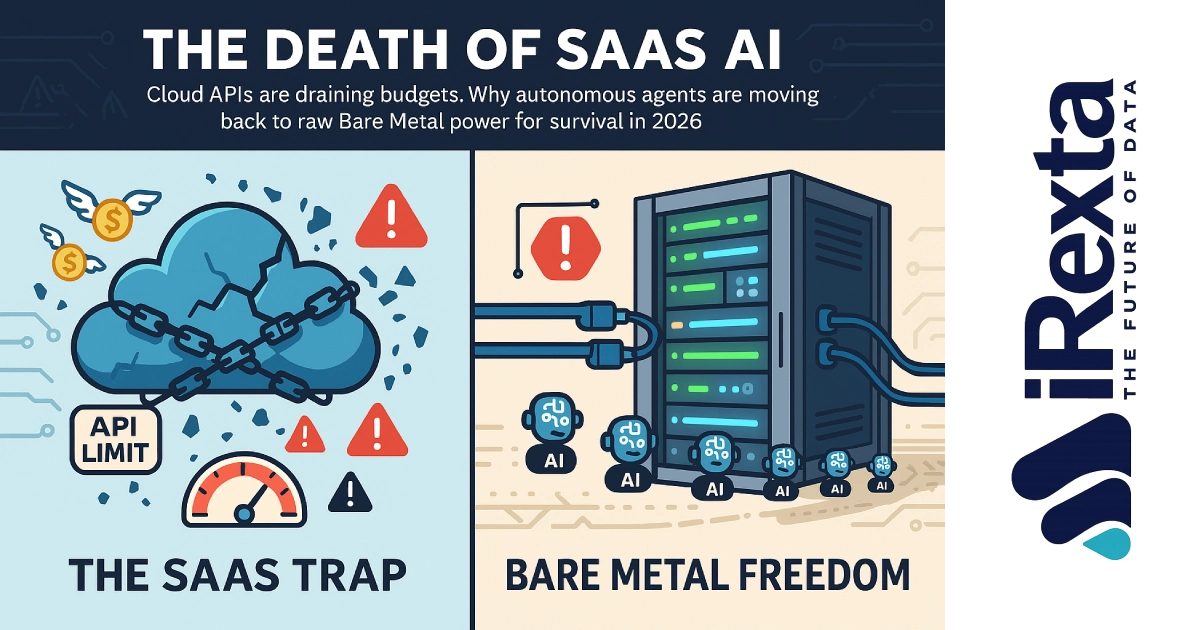
When evaluating infrastructure costs amateur financial models only calculate hourly compute rates. They entirely ignore the massive volume of external application programming interface calls and database queries autonomous agents generate every single second.
Public cloud providers heavily monetize this outbound data flow through exorbitant egress fees. What begins as a cheap virtual machine deployment rapidly scales into thousands of dollars in hidden network charges. Shifting these workloads to unmetered bare metal architecture eliminates this extreme financial hemorrhage completely.
Purpose Built AI Hosting on iRexta Bare Metal
Understanding the absolute truth about orchestration bottlenecks execution latency and physical core density separates amateur developers from elite systems engineers. Purchasing unneeded accelerators is not a universal magic bullet but when balancing the architecture correctly it is mathematically unbeatable in performance per dollar.
At iRexta we recognize that agentic artificial intelligence requires a fundamentally new infrastructure blueprint. By deploying our AMD EPYC powered Bare Metal Servers you establish the ultimate high core density foundation. We provide the precise architectural balance required to keep your accelerators fully saturated and your intelligent agents executing flawlessly at a price point traditional public clouds simply cannot touch.