• /
  • Blog

Type 1 Bare Metal Hypervisors: Building a Private Cloud on Dedicated Servers

Stop overpaying for commercial virtualization licenses. Discover the core architecture critical security warnings and real world use cases of deploying Type 1 hypervisors on premium iRexta bare metal.

Enterprise Virtualization Blueprint

  • Architecture Target: Type 1 Bare Metal Virtualization
  • Recommended Platform: Proxmox VE or Kernel based Virtual Machine
  • Hardware Requirement: Single Tenant Dedicated Server
  • Primary Security Threat: Virtual Machine Escape Vulnerabilities

Introduction: The Evolution of Infrastructure

Modern enterprise environments face a unique computational dilemma. Deploying a single application directly onto a massive physical server wastes tremendous amounts of processing power. Conversely relying entirely on shared public cloud infrastructure generates unpredictable billing spikes and sacrifices data sovereignty.

The definitive solution utilized by top tier Site Reliability Engineers involves transforming unshared physical hardware into a dynamic private cloud. This transformation is achieved through a highly specialized software layer known as a bare metal hypervisor. Understanding how this technology bypasses traditional operating systems is the critical first step in optimizing computational performance and establishing absolute network authority.

Type 1 vs Type 2 Hypervisor Architecture

To comprehend the raw power of bare metal virtualization you must first examine the fatal flaw found in traditional software virtualization. System hypervisors are globally classified into two distinct architectural models based on how they interact with silicon.

Architectural Metric Type 1 Bare Metal Hypervisor Type 2 Hosted Hypervisor
Installation Method Installs directly onto the raw physical hardware components Installs as a standard application on top of a host OS
Hardware Interaction Native direct access to processor memory and storage controllers Must request hardware resources through the host operating system
Performance Latency Near native execution speed with absolute zero abstraction delay High latency due to bloated OS instruction translation layers
Primary Use Case Enterprise Data Centers and High Availability Private Cloud Clusters Personal laptops localized testing and simple software development
Industry Standard Tools Proxmox VE VMware ESXi Microsoft Hyper V XCP ng Oracle VirtualBox VMware Workstation Parallels Desktop

Escaping the Commercial Licensing Crisis

For over a decade legacy platforms stood as the undisputed gold standard for enterprise bare metal virtualization. However recent massive corporate acquisitions have drastically altered the financial ecosystem. Software licensing models have shifted aggressively from perpetual ownership to exorbitant subscription fees forcing IT departments to pay a predatory virtualization tax.

This commercial crisis has triggered a massive industry exodus. Astute infrastructure architects are rapidly migrating their workloads toward powerful open source bare metal hypervisors. Platforms like Proxmox VE utilize native Linux Kernel based Virtual Machine technologies delivering identical high availability clustering live storage migration and software defined networking entirely free of restrictive enterprise licensing costs.

Critical Security Warnings and SRE Best Practices

Many virtualization guides erroneously claim that bare metal hypervisors are inherently immune to cyber attacks because they lack a traditional user operating system. This is a highly dangerous engineering assumption. When you deploy raw virtualization you become the absolute security provider for the entire stack.

The Virtual Machine Escape Threat

The most catastrophic event in virtualization is a Virtual Machine Escape. This occurs when a sophisticated attacker compromises a single guest instance and exploits hypervisor memory vulnerabilities to break out of the isolated environment gaining absolute root command over the physical host and every neighboring tenant.

  • Hardware Isolation Against Side Channels: Deploying virtual machines on a shared public cloud exposes your proprietary data to side channel attacks where malicious actors monitor shared physical processor caches. The only absolute defense is deploying your hypervisor on a Single Tenant Dedicated Server where you control the entire physical silicon boundary.
  • SR IOV Network Partitioning: Relying purely on software defined virtual switches introduces severe input output bottlenecks and security overlap. Enterprise bare metal deployments must utilize Single Root Input Output Virtualization separating network interface cards exactly at the physical hardware layer ensuring compromised virtual machines cannot intercept or flood neighboring traffic.
  • Strict Microsegmentation: You must implement robust zero trust firewall rules directly at the hypervisor level blocking lateral network movement. A compromised public facing web server instance must never possess default internal routing access to your backend database environments.

The Modern Stack: Virtual Machines and Linux Containers

A frequent architectural debate arises regarding whether modern applications should utilize virtual machines or agile container engines. Historically administrators were forced to choose between heavy isolation or lightweight deployment. Modern Type 1 hypervisors eliminate this engineering compromise entirely.

Advanced bare metal platforms natively support dual execution architectures. You can provision a fully hardware emulated Windows Server virtual machine for your legacy applications while simultaneously spinning up dozens of ultra lightweight Linux Containers specifically known as LXC. Because LXC containers share the hypervisor kernel directly they achieve far greater density and computational speed than traditional nested virtualization making your bare metal server an ultimate hybrid deployment engine.

Busting the Energy Consumption Myth

Outdated hosting literature often claims that bare metal hypervisors consume massive amounts of electrical power even during idle periods making them inefficient for variable workloads. This statement completely ignores a decade of microprocessor evolution.

Modern enterprise servers feature advanced Dynamic CPU Frequency Scaling and ACPI C states. When your virtual machines experience low network traffic the hypervisor automatically downclocks the physical processor cores shifting unused silicon into deep sleep states. This intelligent power management combined with the ability to consolidate dozens of legacy physical servers onto a single efficient virtualization node makes modern bare metal infrastructure exceptionally green and financially viable.

Build Your Cloud on iRexta Bare Metal

A bare metal hypervisor is merely an intelligent software layer. Its true performance potential is entirely dictated by the physical machinery it commands. Attempting to run high density virtual machines on inadequate generic hardware results in catastrophic input output bottlenecks and thermal throttling.

iRexta engineers the exact foundational hardware required for flawless virtualization architecture. Our Dedicated Servers provide immense multi core processing power massive ECC memory capacities and enterprise NVMe storage arrays perfectly optimized for demanding hypervisor workloads.

Stop paying predatory licensing fees and abandon shared cloud environments that compromise your operational security. Provision an iRexta bare metal server today install your preferred open source hypervisor and establish an impenetrable private cloud architecture that you absolutely control.
Recent Topics for you

How to Secure AI Agents on Bare Metal Servers | iRexta

How to Secure AI Agents on Bare Metal Servers | iRexta

Stop relying on basic containerization. Understand the lethal trifecta of agent security and how iRexta bare metal servers provide absolute hardware isolation.

Agentic AI Hardware Requirements: CPU vs GPU | iRexta

Agentic AI Hardware Requirements: CPU vs GPU | iRexta

Stop overprovisioning expensive accelerators. Understand why autonomous agents demand massive core density and how iRexta AMD EPYC servers deliver optimal inference performance.

AMD EPYC 8005 Bare Metal Server Review: The Engineering Truth

AMD EPYC 8005 Bare Metal Server Review: The Engineering Truth

Stop falling for hardware marketing illusions. Uncover the architectural realities of the AMD EPYC 8005 processor and how iRexta optimizes it for targeted storage workloads.

What 99.9% vs 99.99% Uptime Really Means (With Downtime Minutes)

What 99.9% vs 99.99% Uptime Really Means (With Downtime Minutes)

Stop falling for the SLA credit trap. Discover the true mathematics behind server downtime the hidden security risks causing outages and how dedicated infrastructure guarantees absolute availability.

Type 1 Bare Metal Hypervisors: Building a Private Cloud on Dedicated Servers

Type 1 Bare Metal Hypervisors: Building a Private Cloud on Dedicated Servers

Escape the commercial virtualization tax. Learn how Type 1 bare metal hypervisors transform dedicated servers into highly secure scalable private clouds.

Docker on Bare Metal: 2026 Private Cloud Guide

Docker on Bare Metal: 2026 Private Cloud Guide

Bypass the hypervisor tax. Learn why deploying Docker directly on bare metal servers with Coolify and NVIDIA GPUs is the ultimate 2026 cloud architecture.

Real-Time Deepfake Detection Infrastructure: Why Cloud VMs Drop Frames and Dedicated GPUs Win

Real-Time Deepfake Detection Infrastructure: Why Cloud VMs Drop Frames and Dedicated GPUs Win

Is your deepfake defense missing critical AI glitches? Discover how hypervisor latency causes dropped frames, and why security teams trust Dedicated Bare Metal GPUs for Zero-Trust video analysis.

The Silent App Killer: IOPS vs. Throughput

The Silent App Killer: IOPS vs. Throughput

You doubled your RAM and CPU, but your database is still crawling. Stop blaming your code. Here is the deep science of storage metrics and how to escape the "Provisioned IOPS" cloud trap.

DBaaS vs. Dedicated Servers: The Real Cost of "Convenience"

DBaaS vs. Dedicated Servers: The Real Cost of "Convenience"

Why high-growth startups are moving their databases back to Bare Metal to save money, boost IOPS, and escape the "Cloud Trap".

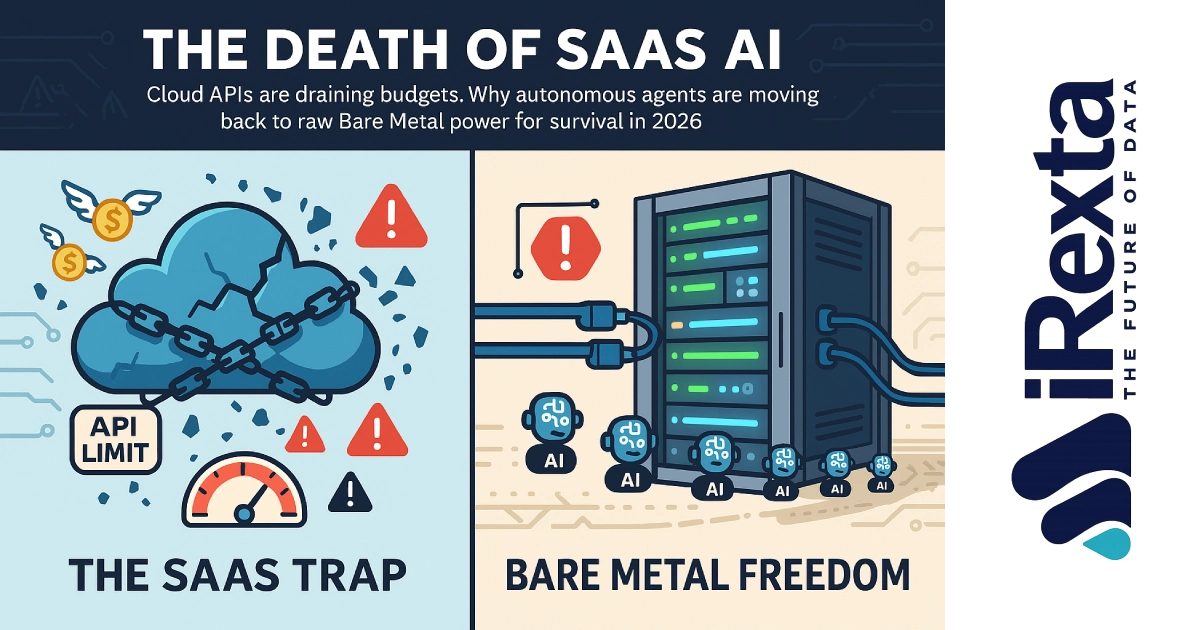
The Death of SaaS: Why AI Agents Are Moving Back to Bare Metal

The Death of SaaS: Why AI Agents Are Moving Back to Bare Metal

AI APIs and Cloud GPUs are draining budgets. Discover why the tech industry is shifting toward Bare Metal Dedicated Servers for running AI Agents in 2026.

Website Bandwidth vs. Data Transfer: The Dedicated Server Guide

Website Bandwidth vs. Data Transfer: The Dedicated Server Guide

Confused by hosting specs? We break down the critical difference between Port Speed (1Gbps) and Monthly Transfer limits so you can stop overpaying for "Unlimited" lies.

VMware is Dead? Switch to Proxmox Bare Metal

VMware is Dead? Switch to Proxmox Bare Metal

Broadcom just broke the contract of trust. Learn why sysadmins are fleeing ESXi for Proxmox, KVM, and ZFS on iRexta Bare Metal.

Why Gaming Companies Are Switching to Bare Metal Servers

Why Gaming Companies Are Switching to Bare Metal Servers

Lag kills games. Discover why top gaming studios choose Bare Metal over Cloud for higher Tick Rates, lower latency, and zero Noisy Neighbors.

TLS vs. SSL: Key Differences & Why You Must Upgrade (2025 Guide)

TLS vs. SSL: Key Differences & Why You Must Upgrade (2025 Guide)

Confused about TLS vs. SSL? Our definitive guide breaks down the critical differences in security, encryption, and performance.

RAID 50 vs RAID 60: Which RAID Configuration Is Best for Your Server Needs?

RAID 50 vs RAID 60: Which RAID Configuration Is Best for Your Server Needs?

Confused between RAID 50 and RAID 60? Discover the key differences, performance comparisons, and best use cases. Learn which configuration suits your server setup in Denver or across Colorado.

Private Networking for Bare Metal Servers

Private Networking for Bare Metal Servers

Discover how private networking for bare metal servers boosts security, reduces latency, and saves bandwidth costs. Learn benefits, use cases, and how it works.

What Are the Risks of Not Having a Dedicated IP Address?

What Are the Risks of Not Having a Dedicated IP Address?

In today's interconnected digital landscape, a dedicated IP address plays a crucial role in ensuring secure, stable, and high-performance access to online services.

What Is the Difference Between SoftRAID and HardRAID? Which One Is Better?

What Is the Difference Between SoftRAID and HardRAID? Which One Is Better?

RAID, short for Redundant Array of Independent Disks, is a foundational technology used in data storage to improve performance, enhance fault tolerance, and ensure high availability.

1

Frequently Asked Questions

What is the difference between a Type 1 and Type 2 hypervisor?
A Type 1 bare metal hypervisor installs directly onto the physical server hardware managing the CPU and memory natively for maximum performance. A Type 2 hosted hypervisor acts as a software application running on top of an existing operating system introducing unnecessary computational overhead and network latency.
Can containers and virtual machines run on the same bare metal hypervisor?
Yes. Modern bare metal platforms like Proxmox VE utilize a hybrid architecture. They allow heavy hardware emulated Virtual Machines powered by KVM and ultra lightweight Linux Containers known as LXC to execute side by side on the identical physical server maximizing resource utilization.
Why are enterprises migrating away from commercial hypervisors to Proxmox?
Following massive corporate acquisitions legacy commercial licensing costs have increased exponentially forcing companies to pay a massive virtualization tax. Enterprises are aggressively migrating to open source alternatives like Proxmox VE to retain enterprise grade clustering capabilities without the predatory billing structures.
Is a bare metal hypervisor completely immune to cyber attacks?
No infrastructure is completely immune. While removing the host operating system reduces the attack surface hypervisors face critical threats like Virtual Machine Escape where malware breaks out of a guest instance. Securing a hypervisor requires hardware level network partitioning and deploying workloads on single tenant dedicated servers.