• /
  • Blog

The Chips Got Faster, The Stack Didn't: Fixing AI Infrastructure Bottlenecks

Stop paying the Hypervisor Tax. Discover why cloud latency, missing NVLink topologies, and network congestion are starving your GPUs, and why true AI scalability demands Dedicated Bare Metal.

Introduction: The Great Compute Illusion

We are operating in an era of unprecedented computational power. NVIDIA’s latest generation of accelerators—such as the B200 and the upcoming Rubin architectures—deliver staggering teraflops of raw compute. Yet, when we speak to enterprise CTOs and MLOps engineers, their primary complaint is rarely about chip speed. Their complaint is about stalled pipelines and unpredictable latency.

The brutal engineering truth is that the bottleneck has migrated. It is no longer the silicon; it is the Infrastructure Stack. Throwing faster GPUs at an AI workload is futile if the underlying network, storage, and virtualization layers are starving those GPUs of data. It is time to look past the hyperscaler marketing and dissect exactly why cloud environments choke modern AI pipelines.

Bottleneck 1: The Hypervisor Tax & Noisy Neighbors

The foundation of public cloud infrastructure is the Virtual Machine (VM). VMs rely on a hypervisor to abstract and share physical hardware among multiple tenants. While this abstraction is fantastic for scaling standard web servers, it is devastating for high-performance AI.

During distributed multi-node LLM training, GPUs must constantly synchronize gradients (All-Reduce operations). If a co-tenant VM on the same physical host experiences a sudden spike in disk I/O or network traffic, the hypervisor interrupts your workload. This "Noisy Neighbor" effect introduces microsecond latency spikes. When a cluster of $30,000 GPUs sits completely idle for even milliseconds waiting for a synchronization packet, the financial waste is astronomical. The Hypervisor Tax is a penalty you pay for flexibility you do not actually use in steady-state AI workloads.

Bottleneck 2: The Storage Wall & GDS Topology

GPUs are only as fast as the data pipelines feeding them. Traditional cloud storage architectures—like attached block storage (EBS) or standard object storage (S3)—were designed for durability, not for the extreme IOPS required by deep learning. This creates the "Storage Wall" where GPUs finish processing a batch of data and stall, waiting for the network.

[Important thing] The GPU-Direct Storage Reality

To bypass this I/O bottleneck, SREs mandate GPU-Direct Storage (GDS) to stream data directly into GPU memory, bypassing the CPU. However, simply plugging an NVMe drive into a server is insufficient. To achieve true GDS, the NVMe drives and GPUs must share the same PCIe Switch (Root Complex). In multi-node clusters, this requires NVMe over Fabrics (NVMe-oF) with RDMA. Bare Metal providers engineer this hardware topology natively; public cloud VMs abstract and break it.

Bottleneck 3: The Serverless GPU FinOps Trap

Many "Neoclouds" aggressively market Serverless GPU endpoints, promising you only pay for the exact seconds your inference code runs. For lightweight tasks, this works. For enterprise LLM inference, it is an architectural and financial disaster.

Loading an 80-billion parameter model into GPU VRAM on-demand introduces a catastrophic Cold Start delay lasting tens of seconds. To fix this, Neoclouds push you to buy "Provisioned Concurrency" (keeping nodes constantly warm). The FinOps Reality: Once you pay for Provisioned Concurrency, your serverless bill rapidly exceeds the cost of simply renting a dedicated Bare Metal server. Production LLM inference demands dedicated, always-on Bare Metal hardware.

Bottleneck 4: Network Congestion & The NVLink Blindspot

In an AI cluster, the network is the computer. For inter-node communication, standard 10Gbps or 25Gbps cloud ethernet will crush your distributed training speeds, dropping packets and stalling GPUs. You require high-speed fabrics like InfiniBand or RoCEv2 (RDMA over Converged Ethernet) to ensure low-latency node-to-node sync.

But the biggest blindspot is Intra-Node communication. Connecting 8 GPUs via standard PCIe lanes inside a single server creates a massive bottleneck. Elite AI infrastructure strictly requires NVIDIA NVLink and NVSwitch topologies to guarantee unrestricted bandwidth between GPUs on the same motherboard. Most cloud VMs do not guarantee this physical topology.

Bottleneck 5: The Cloud Egress Data Catastrophe

The financial bottleneck is just as severe as the technical one. While cloud providers allow you to upload training data for free (Data Ingress), the trap snaps shut during Inference. As your AI products scale to millions of users, constantly streaming generated video, audio, or large embeddings back out of the cloud triggers astronomical "Egress Taxes".

Furthermore, cloud pricing is optimized for spiky web traffic. AI training workloads are fundamentally different; they run at 100% utilization 24/7 for weeks. Paying hourly hyperscaler rates for a continuous workload results in structural overpayment—often 40% to 60% higher than the cost of owning dedicated infrastructure.

The SRE Solution: Cloud Repatriation to iRexta Bare Metal

The fragmented MLOps stack, FinOps traps, and hardware bottlenecks are forcing a massive wave of Cloud Repatriation. In 2026, serious AI teams are migrating their predictable workloads off shared public clouds and back onto dedicated hardware.

At iRexta, we eliminate the infrastructure bottleneck by entirely removing the abstraction layers. By deploying your training and inference workloads on our Dedicated Bare Metal Servers, you receive 1:1, unthrottled access to HGX-class Multi-GPU clusters. We replace the hypervisor tax with absolute hardware authority, substitute sluggish cloud storage with NVMe-oF GDS topologies, and obliterate the Inference Egress Tax with unmetered 100Gbps+ networking. It is time to match the speed of your infrastructure to the speed of your chips.
Recent Topics for you

AI Bottlenecks: Chips Got Faster, Stacks Didn't | iRexta

AI Bottlenecks: Chips Got Faster, Stacks Didn't | iRexta

Fast GPUs fail on slow clouds. Stop hypervisor latency & network bottlenecks from killing AI throughput. See why Bare Metal wins.

Cloud Document AI vs Bare Metal: Hidden Costs | iRexta

Cloud Document AI vs Bare Metal: Hidden Costs | iRexta

Cut AWS Textract fees & cloud egress taxes. Learn why scaling Enterprise Document AI securely requires self-hosted bare metal.

Agentic AI Security Risks: 6 Threats Enterprises Face | iRexta

Agentic AI Security Risks: 6 Threats Enterprises Face | iRexta

Autonomous AI agents operate at machine speed. Learn how to prevent prompt injection, memory poisoning, and metadata exfiltration using Bare Metal isolation and MicroVMs.

How to Secure AI Agents on Bare Metal Servers | iRexta

How to Secure AI Agents on Bare Metal Servers | iRexta

Stop relying on basic containerization. Understand the lethal trifecta of agent security and how iRexta bare metal servers provide absolute hardware isolation.

Agentic AI Hardware Requirements: CPU vs GPU | iRexta

Agentic AI Hardware Requirements: CPU vs GPU | iRexta

Stop overprovisioning expensive accelerators. Understand why autonomous agents demand massive core density and how iRexta AMD EPYC servers deliver optimal inference performance.

AMD EPYC 8005 Bare Metal Server Review: The Engineering Truth

AMD EPYC 8005 Bare Metal Server Review: The Engineering Truth

Stop falling for hardware marketing illusions. Uncover the architectural realities of the AMD EPYC 8005 processor and how iRexta optimizes it for targeted storage workloads.

What 99.9% vs 99.99% Uptime Really Means (With Downtime Minutes)

What 99.9% vs 99.99% Uptime Really Means (With Downtime Minutes)

Stop falling for the SLA credit trap. Discover the true mathematics behind server downtime the hidden security risks causing outages and how dedicated infrastructure guarantees absolute availability.

Type 1 Bare Metal Hypervisors: Building a Private Cloud on Dedicated Servers

Type 1 Bare Metal Hypervisors: Building a Private Cloud on Dedicated Servers

Escape the commercial virtualization tax. Learn how Type 1 bare metal hypervisors transform dedicated servers into highly secure scalable private clouds.

Docker on Bare Metal: 2026 Private Cloud Guide

Docker on Bare Metal: 2026 Private Cloud Guide

Bypass the hypervisor tax. Learn why deploying Docker directly on bare metal servers with Coolify and NVIDIA GPUs is the ultimate 2026 cloud architecture.

Real-Time Deepfake Detection Infrastructure: Why Cloud VMs Drop Frames and Dedicated GPUs Win

Real-Time Deepfake Detection Infrastructure: Why Cloud VMs Drop Frames and Dedicated GPUs Win

Is your deepfake defense missing critical AI glitches? Discover how hypervisor latency causes dropped frames, and why security teams trust Dedicated Bare Metal GPUs for Zero-Trust video analysis.

The Silent App Killer: IOPS vs. Throughput

The Silent App Killer: IOPS vs. Throughput

You doubled your RAM and CPU, but your database is still crawling. Stop blaming your code. Here is the deep science of storage metrics and how to escape the "Provisioned IOPS" cloud trap.

DBaaS vs. Dedicated Servers: The Real Cost of "Convenience"

DBaaS vs. Dedicated Servers: The Real Cost of "Convenience"

Why high-growth startups are moving their databases back to Bare Metal to save money, boost IOPS, and escape the "Cloud Trap".

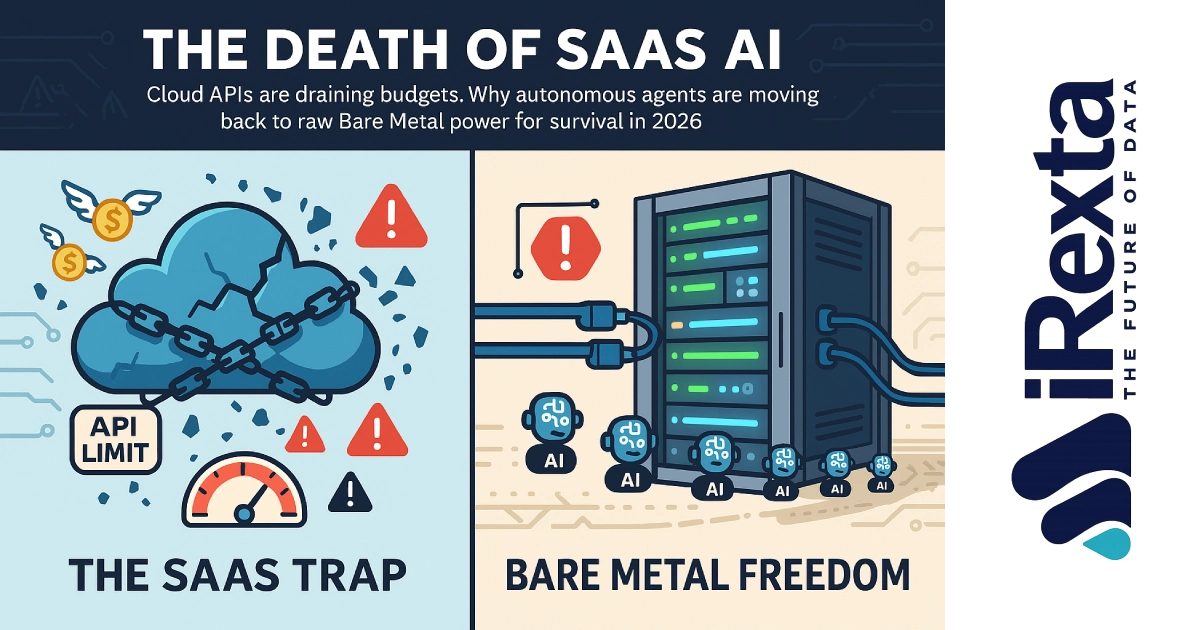
The Death of SaaS: Why AI Agents Are Moving Back to Bare Metal

The Death of SaaS: Why AI Agents Are Moving Back to Bare Metal

AI APIs and Cloud GPUs are draining budgets. Discover why the tech industry is shifting toward Bare Metal Dedicated Servers for running AI Agents in 2026.

Website Bandwidth vs. Data Transfer: The Dedicated Server Guide

Website Bandwidth vs. Data Transfer: The Dedicated Server Guide

Confused by hosting specs? We break down the critical difference between Port Speed (1Gbps) and Monthly Transfer limits so you can stop overpaying for "Unlimited" lies.

VMware is Dead? Switch to Proxmox Bare Metal

VMware is Dead? Switch to Proxmox Bare Metal

Broadcom just broke the contract of trust. Learn why sysadmins are fleeing ESXi for Proxmox, KVM, and ZFS on iRexta Bare Metal.

Why Gaming Companies Are Switching to Bare Metal Servers

Why Gaming Companies Are Switching to Bare Metal Servers

Lag kills games. Discover why top gaming studios choose Bare Metal over Cloud for higher Tick Rates, lower latency, and zero Noisy Neighbors.

TLS vs. SSL: Key Differences & Why You Must Upgrade (2025 Guide)

TLS vs. SSL: Key Differences & Why You Must Upgrade (2025 Guide)

Confused about TLS vs. SSL? Our definitive guide breaks down the critical differences in security, encryption, and performance.

RAID 50 vs RAID 60: Which RAID Configuration Is Best for Your Server Needs?

RAID 50 vs RAID 60: Which RAID Configuration Is Best for Your Server Needs?

Confused between RAID 50 and RAID 60? Discover the key differences, performance comparisons, and best use cases. Learn which configuration suits your server setup in Denver or across Colorado.

Private Networking for Bare Metal Servers

Private Networking for Bare Metal Servers

Discover how private networking for bare metal servers boosts security, reduces latency, and saves bandwidth costs. Learn benefits, use cases, and how it works.

What Are the Risks of Not Having a Dedicated IP Address?

What Are the Risks of Not Having a Dedicated IP Address?

In today's interconnected digital landscape, a dedicated IP address plays a crucial role in ensuring secure, stable, and high-performance access to online services.

What Is the Difference Between SoftRAID and HardRAID? Which One Is Better?

What Is the Difference Between SoftRAID and HardRAID? Which One Is Better?

RAID, short for Redundant Array of Independent Disks, is a foundational technology used in data storage to improve performance, enhance fault tolerance, and ensure high availability.

1

Frequently Asked Questions

Why are AI workloads migrating from AWS to Bare Metal?
Cloud environments are designed for variable workloads, but AI training and production inference require sustained, 24/7 compute. Paying hourly hyperscaler rates for steady-state AI workloads results in massive overpayment. Migrating to Bare Metal provides a fixed, predictable cost, eliminating unexpected 'pay-as-you-go' bills and astronomical inference data egress fees.
What is the 'Storage Wall' in AI Infrastructure?
The Storage Wall occurs when incredibly fast GPUs (like H100s) sit idle because legacy cloud storage or slow network-attached block storage cannot feed training data fast enough. To bypass this, SREs must deploy GPU-Direct Storage (GDS). However, the NVMe drives and GPUs must share the same PCIe Root Complex via NVMe-oF RDMA to successfully bypass the CPU and sustain maximum throughput.
Are Serverless GPUs good for production LLM inference?
No. While Serverless GPUs are fine for prototyping, they suffer from severe 'Cold Start' latency. Loading a massive 70B parameter model from disk into GPU VRAM on-demand can take tens of seconds. If you use 'Provisioned Concurrency' to keep nodes warm, your cloud bill will exceed the cost of simply renting a dedicated Bare Metal server. Production inference demands dedicated, always-on instances.
How does network congestion impact distributed AI training?
Distributed training relies on continuous gradient synchronization across multiple nodes (All-Reduce operations). Standard cloud ethernet easily congests, dropping packets and stalling GPUs. High-speed fabrics like InfiniBand or RoCEv2 (RDMA over Converged Ethernet) are strictly required for inter-node sync, while NVIDIA NVLink and NVSwitch are mandatory for intra-node bandwidth.
What is the Hypervisor Tax in cloud AI?
Cloud Virtual Machines (VMs) share physical hardware through a Hypervisor. This virtualization layer introduces interrupt latency and 'noisy neighbor' I/O contention. For latency-sensitive AI workloads, this translates to a 10% to 20% loss in total hardware throughput. Bare Metal servers remove this tax entirely, offering 1:1 hardware access.