• /
  • Blog

Beyond Docker: Building Sub-Millisecond Microservices with WebAssembly (Wasm) on Bare Metal

Escape the AWS Lambda egress tax and Docker bloat. Deploy WebAssembly (Wasm) microservices on Bare Metal for 10,000x density and zero cold starts.

The deployment pipeline is collapsing under its own weight. For the last decade, the tech industry accepted a fundamental compromise: to achieve isolation and portability, we wrapped our 5MB microservices inside 250MB Linux environments. We orchestrated them with Kubernetes, routed them through heavy service meshes, and paid cloud providers a premium for the privilege.

When traffic spiked, we fled to AWS Lambda and Serverless platforms, trading container bloat for the punishing Cloud Egress Tax and the unpredictable latency of "cold starts."

But the architectural tectonic plates are shifting. WebAssembly (Wasm), once a curious browser plugin designed to run 3D games in Chrome, has escaped the browser. Powered by WASI (WebAssembly System Interface) and runtimes like Fermyon Spin and Wasmtime, server-side Wasm is dismantling the traditional microservice model.

In this CTO Masterclass, we will explore why Docker is no longer the final evolution of backend architecture, and how deploying Wasm on iRexta Bare Metal servers allows enterprises to build their own sub-millisecond, hyper-dense serverless platforms at a fraction of public cloud costs.

Phase 1: The Docker Bloat and the AWS Lambda Trap

To understand Wasm’s superiority, we must first confront the inefficiency of current isolation models.

  • The Docker Weight: Docker achieves isolation through Linux namespaces and cgroups. However, every container requires a base OS filesystem (like Alpine or Ubuntu), package managers, and language runtimes. A simple Python or Node.js API endpoint often results in a 200MB to 500MB container image. When scaling up, loading these images and booting the OS processes takes hundreds of milliseconds, or even seconds.
  • The Serverless Trap: To avoid managing clusters, CTOs migrate to FaaS (Function-as-a-Service) like AWS Lambda. Under the hood, Lambda uses Firecracker microVMs. While highly secure, you are still booting a micro-OS. Furthermore, you pay a "Per-Execution Tax." At 10 million invocations a day, the meter spins endlessly, transforming a predictable hardware cost into an infinitely scaling OPEX nightmare.

Phase 2: The WebAssembly Revolution (Zero Cold Starts)

WebAssembly is a radically different computing model. It is a portable, low-level binary instruction format. Wasm modules do not contain an operating system, a file system, or a network stack. They are pure, pre-compiled computational logic.

Because there is no OS to boot, Wasm eliminates the concept of a cold start. Runtimes like Wasmtime instantiate Wasm modules in under 0.5 milliseconds (Sub-millisecond latency).

V8 Isolates vs. AOT Compilation

Competitors often praise Cloudflare Workers for their speed. Cloudflare uses V8 Isolates (a JavaScript engine mechanism) to run Wasm. However, when you deploy Wasm on Bare Metal using the Wasmtime engine, you utilize Ahead-of-Time (AOT) compilation. Cranelift (Wasmtime’s compiler) translates the Wasm bytecode directly into optimized native machine code. For heavy computational logic and AI workloads, Bare Metal AOT Wasm will consistently outpace V8 Isolates.

Phase 3: The 10,000x Extreme Density Math (Hardware Specs Sizing)

If Wasm is faster, how does it save money? The answer lies in execution density. In a standard Docker setup, containers carry a base memory footprint of 30MB to 50MB before processing traffic. A Wasm module requires a meager 2MB to 5MB and can be instantiated, executed, and destroyed in microseconds on demand.

To demonstrate how CTOs can size their infrastructure, here is the hardware sizing matrix on iRexta Bare Metal:

  • Entry-Level / Edge Nodes (8-Core CPU / 32GB RAM):
    • Capacity: 1,000 to 3,000 concurrent Wasm microservices.
    • Ideal Workload: Regional API routing, authentication gates, rate limiting, and edge webhooks.
  • Mid-Tier Enterprise Clusters (32-Core CPU / 128GB RAM):
    • Capacity: 10,000 to 20,000 concurrent Wasm microservices.
    • Ideal Workload: E-commerce checkout pipelines, JSON transformations, and payment gateway processors.
  • High-End Super-Dense Nodes (128-Core CPU / 512GB RAM):
    • Capacity: 50,000+ concurrent Wasm microservices + Symbiotic Docker Stateful DBs.
    • Ideal Workload: High-frequency data streaming, Vector Embeddings routing, fintech real-time fraud detection, and multi-tenant Edge SaaS.

You do not need 10 AWS EC2 instances. You need one Bare Metal machine.

Phase 4: The Component Model (Nanosecond Microservices)

Here is the true "Hidden Gem" of the Wasm ecosystem that most cloud architects miss.

In a traditional Docker architecture, if a Python microservice needs to talk to a Rust microservice, it serializes data into JSON, opens a TCP socket, initiates a TLS handshake, sends an HTTP request, and waits for deserialization. This network hop costs milliseconds.

With the WASI 0.2 Component Model, this overhead is entirely erased. The Component Model defines WebAssembly Interface Types (WIT). It allows a Python Wasm component and a Rust Wasm component to be composed together into a single binary. They communicate by directly passing structured data via the Canonical ABI (Application Binary Interface). Instead of risky shared memory, the Canonical ABI strictly copies and translates typed interfaces, maintaining absolute memory isolation between components.

No network. No JSON. No TCP. Inter-service communication shifts from milliseconds over HTTP to nanoseconds via in-process function calls. It is the modularity of microservices with the execution speed of a monolithic C++ binary.

The Asynchronous I/O Bottleneck

When bringing Wasm microservices to production, beware of I/O blocking. Older WASI 0.2 implementations handle I/O synchronously, meaning a database call blocks the entire Wasm instance. Elite SREs ensure their runtimes utilize WASI 0.3 native Async I/O or leverage the asynchronous event loops built into frameworks like Fermyon Spin to handle high-performance database queries without locking the CPU thread.

Phase 5: Ironclad Security (Default Deny-All Sandbox)

Speed and density are meaningless without security.

The Shared Kernel Threat

Docker containers share the host’s Linux kernel. If an attacker discovers a kernel exploit (like an runc escape), they can break out of the container and compromise the entire Bare Metal node.

WebAssembly was forged in the hostile environment of the web browser. It operates on a "Default Deny-All" Capability-based Security model. A Wasm module running in Fermyon Spin or Wasmtime has zero access to the host. It cannot read a file, check the system clock, or open a network socket unless the host explicitly grants it that specific WIT capability. If a hacker exploits a buffer overflow in your Wasm code, they are trapped inside a tightly restricted linear memory sandbox. They cannot touch the host OS.

Phase 6: The Polyglot Reality (Language Support Matrix)

A common doubt among engineering leads is whether their existing codebase can compile to Wasm. Wasm is language-agnostic, but toolchain maturity varies:

  • First-Class Native Support (Rust, C/C++, Go): Compiles directly to lightweight .wasm binaries using cargo-component or TinyGo with minimal footprint and peak execution speeds.
  • Managed & Scripted Support (Python, JavaScript/TypeScript): Uses tools like componentize-py and jco (ComponentizeJS) to bundle a lightweight interpreter inside the sandbox, enabling full Wasm Component Model compatibility for web APIs and serverless handlers.

Phase 7: The Progressive Migration Roadmap (Docker to Wasm)

You do not need to rewrite your entire architecture overnight. Elite engineering teams execute a 4-step progressive migration:

  1. Step 1: Identify Candidates: Isolate stateless, high-frequency HTTP endpoints, authentication middleware, and event-driven webhooks. Leave databases in Docker.
  2. Step 2: Deploy the Wasm Sidecar / Gateway: Install Fermyon Spin or SpinKube on iRexta Bare Metal alongside your existing infrastructure.
  3. Step 3: Route Stateless Traffic: Direct incoming API traffic to Wasm components. Enjoy instantaneous sub-millisecond scaling without cold starts.
  4. Step 4: Establish the Symbiotic Hybrid State: Retain Docker exclusively for heavy stateful services (PostgreSQL, Redis, Kafka) while routing 100% of stateless compute to high-dense Bare Metal Wasm.

Phase 8: The iRexta Bare Metal Strategy (Your Private Serverless Cloud)

The industry narrative pushes developers to use Wasm inside existing Kubernetes Docker clusters. While wrapping Wasm in Docker (via runwasi) is a safe transitional step, it defeats Wasm's primary advantages: you inherit Docker's bloat and lose the sub-millisecond startup times.

The ultimate CTO playbook is deploying Fermyon Spin or Wasmtime directly on iRexta Bare Metal.

By provisioning dedicated hardware, you step entirely outside the public cloud ecosystem. You stop paying the AWS per-execution tax. You bypass the Cloud Egress Tax for data transit. You achieve higher execution density than Kubernetes could ever offer with Docker. You effectively transform your Bare Metal infrastructure into a globally scalable, sub-millisecond, hyper-dense Serverless platform—fully under your financial and operational control.
The Stateful Illusion

Do not throw away Docker entirely. WebAssembly is the undisputed king of stateless compute (API gateways, serverless functions, data processing, edge routing). However, for heavy, stateful legacy applications like PostgreSQL, Redis, or Kafka, Docker remains the superior architecture. Modern Bare Metal deployments utilize a symbiotic hybrid approach: Docker for stateful data layers, and Wasm for lightning-fast, stateless compute logic.

Recent Topics for you

Beyond Docker: Sub-Millisecond Wasm Microservices on Bare Metal

Beyond Docker: Sub-Millisecond Wasm Microservices on Bare Metal

Escape Docker bloat and AWS Lambda taxes. Deploy WebAssembly (Wasm) microservices on Bare Metal for 10,000x density and zero cold starts.

Validate Bare Metal GPUs & Scale AI: Triton vs vLLM

Validate Bare Metal GPUs & Scale AI: Triton vs vLLM

Master AI infrastructure on bare metal. Learn to stress-test GPUs with NVIDIA DCGM & NCCL, and scale deployments using Triton Inference Server vs vLLM.

Fix LangGraph Crashes: Temporal AI Agents on Bare Metal

Fix LangGraph Crashes: Temporal AI Agents on Bare Metal

Fix LangGraph crashes. Deploy Temporal for durable AI agent orchestration on Bare Metal NVMe. Escape SaaS runtime fees and cloud IOPS limits.

The Sovereign AI Gateway: Ditch Cloud Egress & Self-Host Envoy

The Sovereign AI Gateway: Ditch Cloud Egress & Self-Host Envoy

Ditch AWS egress traps and SaaS taxes. Self-host the open-source Envoy AI Gateway on Bare Metal. Master stateless MCP routing and NIST security.

Istio Architecture: The Definitive Guide to Ambient Mesh

Istio Architecture: The Definitive Guide to Ambient Mesh

Deep dive into Istio Ambient Mesh architecture. Compare Azure vs Istio, decode Ztunnel magic, HBONE, and the eBPF vs iptables debate.

AI Bottlenecks: Chips Got Faster, Stacks Didn't | iRexta

AI Bottlenecks: Chips Got Faster, Stacks Didn't | iRexta

Fast GPUs fail on slow clouds. Stop hypervisor latency & network bottlenecks from killing AI throughput. See why Bare Metal wins.

Cloud Document AI vs Bare Metal: Hidden Costs | iRexta

Cloud Document AI vs Bare Metal: Hidden Costs | iRexta

Cut AWS Textract fees & cloud egress taxes. Learn why scaling Enterprise Document AI securely requires self-hosted bare metal.

Agentic AI Security Risks: 6 Threats Enterprises Face | iRexta

Agentic AI Security Risks: 6 Threats Enterprises Face | iRexta

Autonomous AI agents operate at machine speed. Learn how to prevent prompt injection, memory poisoning, and metadata exfiltration using Bare Metal isolation and MicroVMs.

How to Secure AI Agents on Bare Metal Servers | iRexta

How to Secure AI Agents on Bare Metal Servers | iRexta

Stop relying on basic containerization. Understand the lethal trifecta of agent security and how iRexta bare metal servers provide absolute hardware isolation.

Agentic AI Hardware Requirements: CPU vs GPU | iRexta

Agentic AI Hardware Requirements: CPU vs GPU | iRexta

Stop overprovisioning expensive accelerators. Understand why autonomous agents demand massive core density and how iRexta AMD EPYC servers deliver optimal inference performance.

AMD EPYC 8005 Bare Metal Server Review: The Engineering Truth

AMD EPYC 8005 Bare Metal Server Review: The Engineering Truth

Stop falling for hardware marketing illusions. Uncover the architectural realities of the AMD EPYC 8005 processor and how iRexta optimizes it for targeted storage workloads.

What 99.9% vs 99.99% Uptime Really Means (With Downtime Minutes)

What 99.9% vs 99.99% Uptime Really Means (With Downtime Minutes)

Stop falling for the SLA credit trap. Discover the true mathematics behind server downtime the hidden security risks causing outages and how dedicated infrastructure guarantees absolute availability.

Type 1 Bare Metal Hypervisors: Building a Private Cloud on Dedicated Servers

Type 1 Bare Metal Hypervisors: Building a Private Cloud on Dedicated Servers

Escape the commercial virtualization tax. Learn how Type 1 bare metal hypervisors transform dedicated servers into highly secure scalable private clouds.

Docker on Bare Metal: 2026 Private Cloud Guide

Docker on Bare Metal: 2026 Private Cloud Guide

Bypass the hypervisor tax. Learn why deploying Docker directly on bare metal servers with Coolify and NVIDIA GPUs is the ultimate 2026 cloud architecture.

Real-Time Deepfake Detection Infrastructure: Why Cloud VMs Drop Frames and Dedicated GPUs Win

Real-Time Deepfake Detection Infrastructure: Why Cloud VMs Drop Frames and Dedicated GPUs Win

Is your deepfake defense missing critical AI glitches? Discover how hypervisor latency causes dropped frames, and why security teams trust Dedicated Bare Metal GPUs for Zero-Trust video analysis.

The Silent App Killer: IOPS vs. Throughput

The Silent App Killer: IOPS vs. Throughput

You doubled your RAM and CPU, but your database is still crawling. Stop blaming your code. Here is the deep science of storage metrics and how to escape the "Provisioned IOPS" cloud trap.

DBaaS vs. Dedicated Servers: The Real Cost of "Convenience"

DBaaS vs. Dedicated Servers: The Real Cost of "Convenience"

Why high-growth startups are moving their databases back to Bare Metal to save money, boost IOPS, and escape the "Cloud Trap".

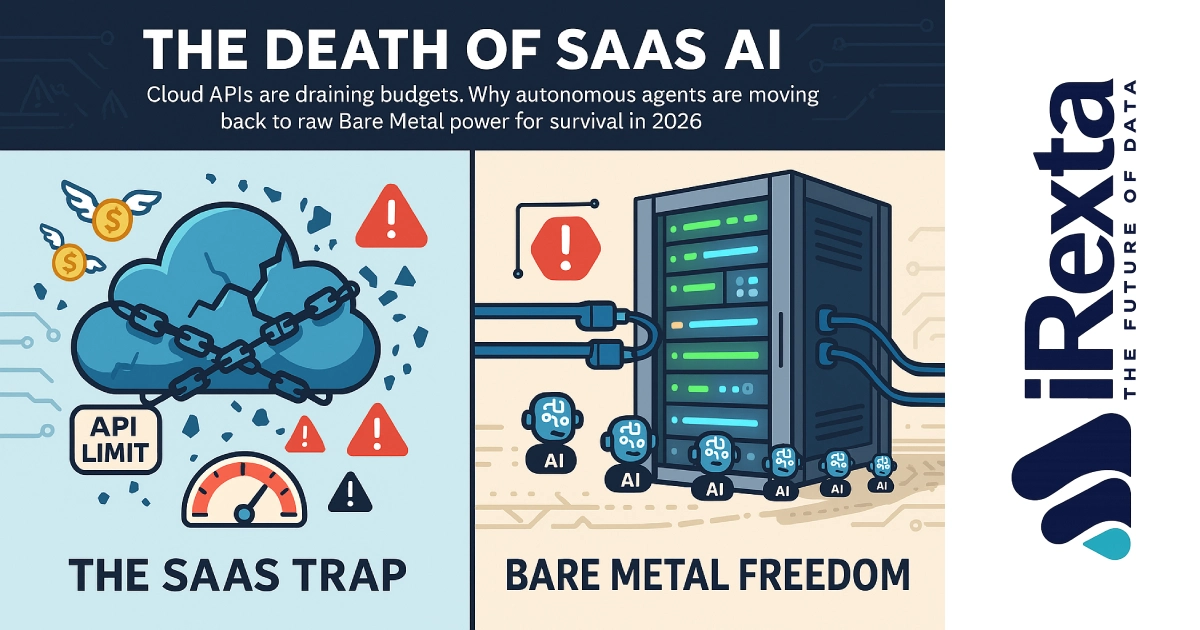
The Death of SaaS: Why AI Agents Are Moving Back to Bare Metal

The Death of SaaS: Why AI Agents Are Moving Back to Bare Metal

AI APIs and Cloud GPUs are draining budgets. Discover why the tech industry is shifting toward Bare Metal Dedicated Servers for running AI Agents in 2026.

Website Bandwidth vs. Data Transfer: The Dedicated Server Guide

Website Bandwidth vs. Data Transfer: The Dedicated Server Guide

Confused by hosting specs? We break down the critical difference between Port Speed (1Gbps) and Monthly Transfer limits so you can stop overpaying for "Unlimited" lies.

VMware is Dead? Switch to Proxmox Bare Metal

VMware is Dead? Switch to Proxmox Bare Metal

Broadcom just broke the contract of trust. Learn why sysadmins are fleeing ESXi for Proxmox, KVM, and ZFS on iRexta Bare Metal.

Why Gaming Companies Are Switching to Bare Metal Servers

Why Gaming Companies Are Switching to Bare Metal Servers

Lag kills games. Discover why top gaming studios choose Bare Metal over Cloud for higher Tick Rates, lower latency, and zero Noisy Neighbors.

TLS vs. SSL: Key Differences & Why You Must Upgrade (2025 Guide)

TLS vs. SSL: Key Differences & Why You Must Upgrade (2025 Guide)

Confused about TLS vs. SSL? Our definitive guide breaks down the critical differences in security, encryption, and performance.

RAID 50 vs RAID 60: Which RAID Configuration Is Best for Your Server Needs?

RAID 50 vs RAID 60: Which RAID Configuration Is Best for Your Server Needs?

Confused between RAID 50 and RAID 60? Discover the key differences, performance comparisons, and best use cases. Learn which configuration suits your server setup in Denver or across Colorado.

Private Networking for Bare Metal Servers

Private Networking for Bare Metal Servers

Discover how private networking for bare metal servers boosts security, reduces latency, and saves bandwidth costs. Learn benefits, use cases, and how it works.

What Are the Risks of Not Having a Dedicated IP Address?

What Are the Risks of Not Having a Dedicated IP Address?

In today's interconnected digital landscape, a dedicated IP address plays a crucial role in ensuring secure, stable, and high-performance access to online services.

What Is the Difference Between SoftRAID and HardRAID? Which One Is Better?

What Is the Difference Between SoftRAID and HardRAID? Which One Is Better?

RAID, short for Redundant Array of Independent Disks, is a foundational technology used in data storage to improve performance, enhance fault tolerance, and ensure high availability.

1

Enterprise & SRE Technical FAQ

Why are Wasm cold starts measured in microseconds while AWS Lambda takes seconds?
AWS Lambda utilizes Firecracker microVMs or Docker containers. To process a new request, Lambda must boot a minimal Guest OS, initialize the runtime environment (like the JVM or Node engine), and then load your code. WebAssembly bypasses the OS completely. Runtimes like Wasmtime load pre-compiled, highly optimized bytecode directly into memory without booting an operating system, achieving instantiation times as low as 0.5 milliseconds (Sub-millisecond).
Does WebAssembly entirely replace Docker on Bare Metal servers?
No. WebAssembly and Docker solve different architectural problems. Docker is optimized for porting entire OS environments, making it ideal for large, stateful services like PostgreSQL, Redis, or monolithic legacy applications. WebAssembly is optimized for pure computational logic. For APIs, edge computing, serverless functions, and event-driven microservices, Wasm provides 100x the density and speed of Docker. Elite SREs run a hybrid architecture, pairing Docker for state and Wasm for stateless compute.
How does the Wasm Component Model eliminate network latency between microservices?
Traditional microservices suffer from massive network overhead because they communicate via HTTP/TCP and serialize payloads into JSON. Using the WASI 0.2 Component Model, developers can take Wasm binaries written in different languages (e.g., Rust and Python) and link them together natively. Instead of utilizing the network stack, these components communicate via the Canonical ABI, which securely copies and translates typed data without exposing raw shared memory. This reduces inter-service communication latency from milliseconds to nanoseconds.
Can I run Python and TypeScript applications in WebAssembly without rewriting them in Rust?
Yes. While Rust and Go offer the smallest binary footprints, tools like componentize-py (for Python) and jco (for JavaScript/TypeScript) allow developers to package existing code and standard library dependencies into compliant WASI 0.2 Wasm components. This allows engineering teams to deploy polyglot microservices without abandoning their existing codebases or developer skill sets.